
anrés jaque on working with the ‘not yet here’
At Columbia University Graduate School of Architecture Planning and Preservation in New York, we visit Andrés Jaque to discuss how his work reframes utopia as an inclusive and evolving position within architecture. Speaking from his office, surrounded by research material and project studies, he situates his practice within a broader set of environmental and political conditions. He describes what drives his approach: ‘I see architecture as a way of anticipating possibilities that are not yet here.‘
Jaque’s perspective is shaped through Office for Political Innovation, a Madrid- and New York-based studio that works across scales, always remaining attentive to the systems each project engages. Discussing utopia, he notes: ‘I don’t think for us, utopia is something about speculation, but actually about finding the tensions in the present that can announce possibilities that would be desirable to make possible.‘
This position runs through many of his works, especially the Reggio School, whose cork facade supports microbial life, or ongoing investigations into mining industries as he and his team trace the harmful environmental and social impacts of the construction process.

Andrés Jaque, image © designboom
office for political innovation: dreams as design method
Architect Andrés Jaque points to the instability of current systems. He notes: ‘the world in which we’re living is sinking,‘ while also identifying opportunity within that state. ‘It’s no longer something that is an alternative to what exists,‘ he continues, ‘it’s potential that is growing within the cracks of a system that’s in crisis.‘
His work approaches these conditions through collaboration. He brings together architects, scientists, and activists to address questions that extend beyond the boundaries of just one discipline.
The discussion also reflects a broader shift in architecture, where provocative representation gives way to direct engagement with materials and social processes. Jaque describes a move toward practices that ‘mobilize things’ rather than simply render them.
This idea aligns design with real-world action that reshapes environments and relationships. In this context, Andrés Jaque poses Utopia as an active framework which expands the role of architecture and remains grounded in the realities it seeks to transform.

The Transspecies Palace, Office for Political Innovation, Milan, Italy, 2025. image © José Hevia (see here)
dialogue with andrés jaque
designboom (DB): We’re exploring ‘what if’ as an optimistic way of thinking that helps our dreams become reality. When you begin a project, do you start with a question like that?
Andrés Jaque (AJ): Yes, definitely. I see architecture as a way of anticipating possibilities that are not yet here. We always work with the ‘not yet here,’ with something that is yet to come. And the ‘yet to come’ gives architecture the role of expanding the spectrum of what’s possible.
I think that’s a notion of utopia that keeps me very idealistic, but also practical and somehow grounded. For us, utopia is not about speculation, but about finding tensions in the present that can announce possibilities that would be desirable to make possible.
Your question is very timely. It’s needed, because the world we’re living in is sinking. There are many forms of control that are overlapping and stuck together: destructivism, racialization, patriarchy, technocracy, and also anthropocentrism. These are systems that architecture has helped to produce through modernism. But now it’s cracking, and many exciting things are happening in the cracks.
Utopia is no longer something that exists as an alternative to what is here. It is potential growing within the cracks of a system in crisis. That’s very exciting, because architecture has a clear role there.
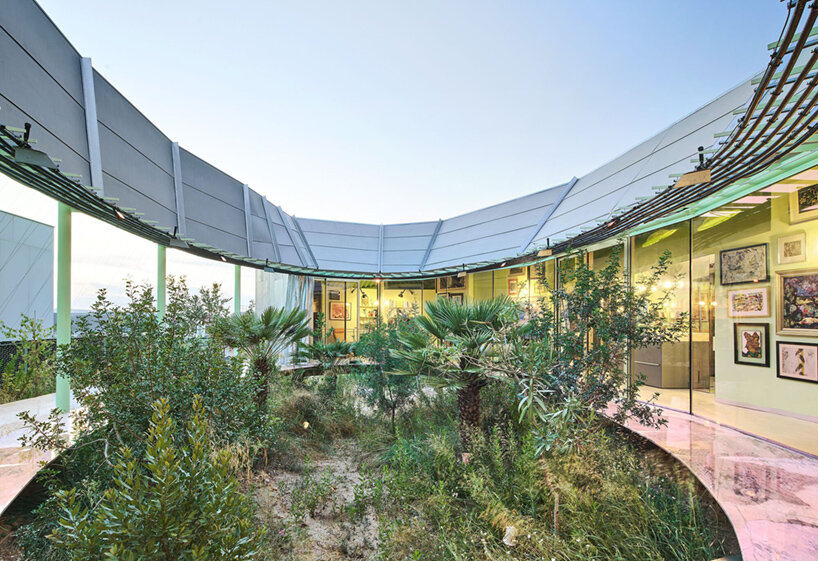
Rambla Climate House, Office for Political Innovation, Molina de Segura, Spain, 2021. image © José Hevia (see here)
DB: Can you give some examples of what you see as growing in these cracks?
AJ: Very literally, we designed the Reggio School as an opportunity for architecture to cater to extended ecosystems, to more-than-human life, connecting humans to landscapes and to many forms of life that are necessary for survival.
The school is located on a former landfill in Madrid, a place with very little biodiversity compared to its surroundings. The project had a responsibility to restore conditions needed for both human and non-human life. This includes air quality and environmental health for breathing, eating, and digestion.
We worked through the materiality of the building. One strategy was developing a façade made of multiple layers of cork. Cork, sourced locally in Spain, has tiny pores that allow fungi and mycelium to grow. It naturally becomes an ecology. The microorganisms and biodiversity that grow within it influence air, water, and surrounding systems.
The facade has a muddy, irregular appearance. What matters is that we are now tracking the life within it with scientists and microbiologists. The biodiversity in the cork is extensive. This is consistent with cork’s role in wine fermentation, where it supports microbial life.
We are also observing how the building affects the soil. It is becoming more inhabited, and insect populations are increasing. This work involves scientists and activists.
This is a role for architecture: restoring what has been broken, while imagining expanded possibilities. It is about increasing the realm of what is possible.
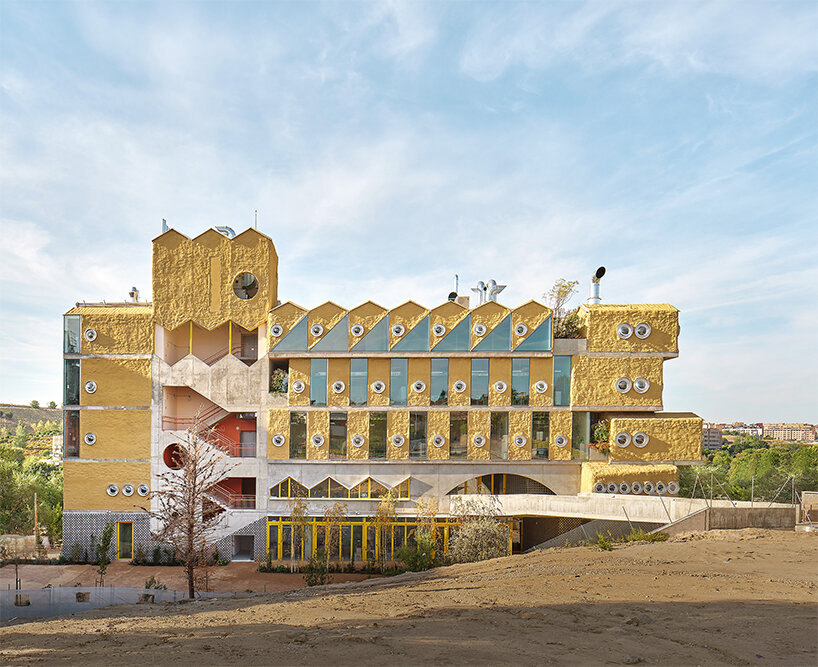
Colegio Reggio, Office for Political Innovation, Madrid, Spain, 2022. image © José Hevia (see here)
DB: In what other ways does your team collaborate with different disciplines?
AJ: We work closely with activists, which is crucial. Architects are no longer solo authors. This is not a moral position, but a practical necessity. If we want to be relevant or impactful, we need to work with others.
Design, discourse, and activism are inseparable now. This is very different from architecture twenty years ago, when architects often positioned themselves as provocateurs. There is no longer space for disengaged provocation. Engagement is essential, and engagement means collaboration.
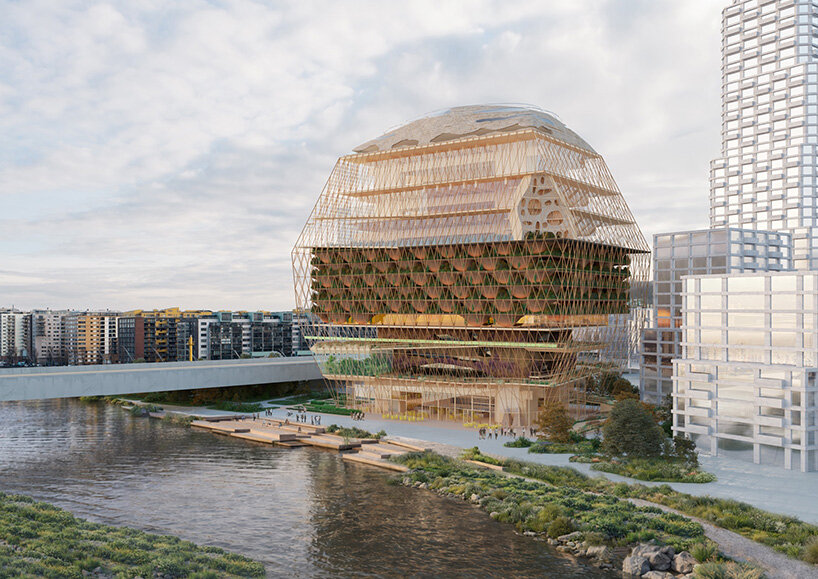
Planetary Landmark for the Climate Age, Office for Political Innovation, Shift, competition (see here)
DB: I’ve noticed that in the past couple of decades there was a strong interest in experimental formal gestures through digital modeling or parametric tools. More recently there seems to be a shift toward handcraft techniques or learning from local communities. Have you noticed this as well?
AJ: Absolutely. Two things are crucial right now. First, people are less interested in representation and more interested in mobilization. It’s not about producing images that inspire. It’s about bringing realities into existence and involving people in those processes.
A large part of early 2000s architecture focused on representation or large gestures. Those gestures are relatively easy. The challenge now is to bring reality into our lives.
It’s also about redefining what architecture is. Younger designers are less interested in delegating complexity to technological aesthetics. Technology is no longer understood as increasingly complex systems. It’s about how societies and ecosystems are constructed.
Previously, the idea of technology was influenced by institutions like NASA, suggesting progress and advancement. Today, the understanding is closer to Bruno Latour’s idea that technology is society made durable (see here).
The question becomes how we organize the world so it is inclusive, represents values, and creates conditions for a desirable life that respects others. This includes building ecosystems and societies that can coexist. That is the notion of technology that resonates now.
Many people also question the idea that technological advancement automatically improves life. There is a growing awareness that it can also be destructive.
DB: This idea actually connects quite closely to the current show at the New Museum, New Humans: Memories of the Future, which looks at how technological shifts reshape what it means to be human.
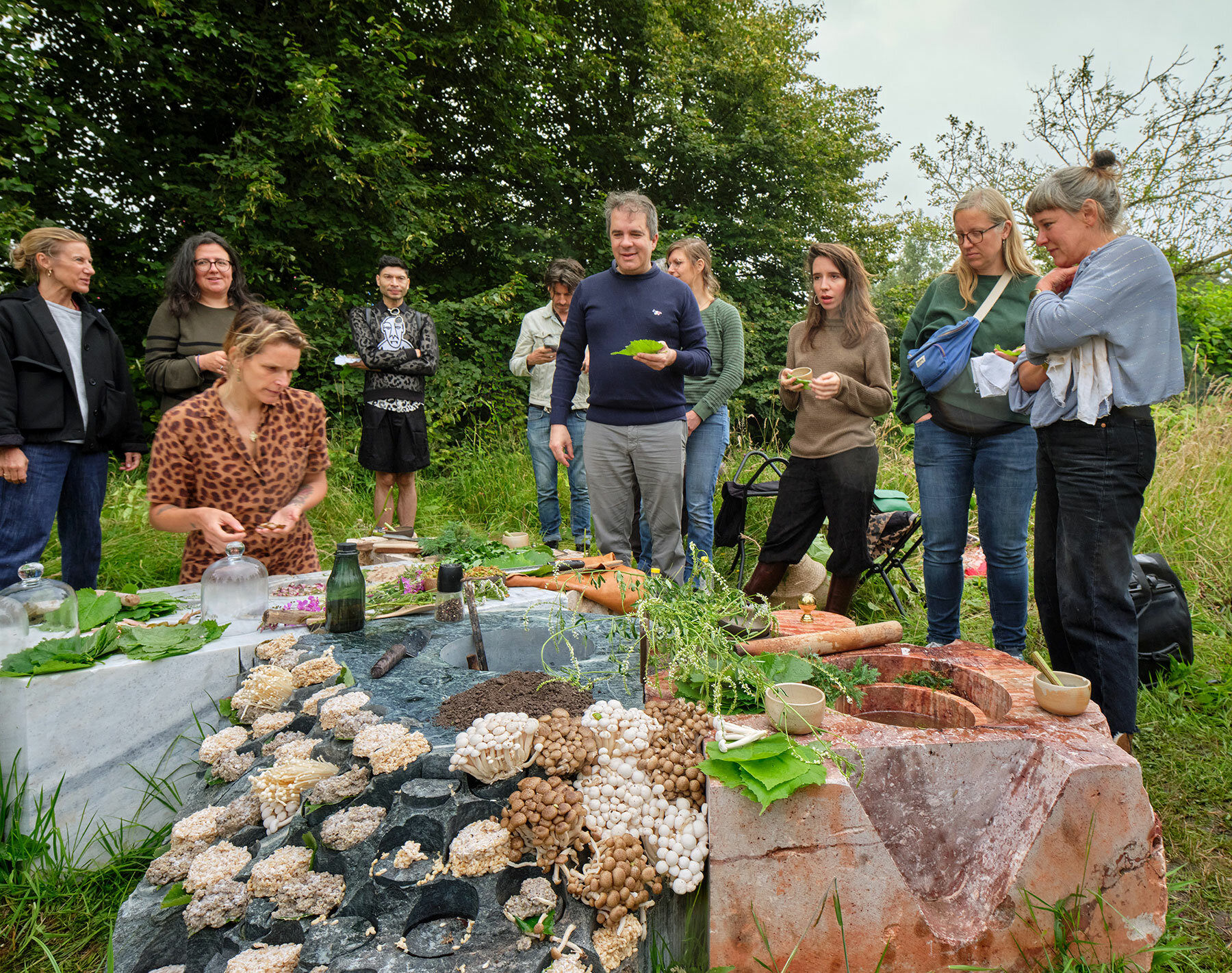
The Transspecies Kitchen, Office for Political Innovation, Antwerp, Belgium, 2024. image © José Hevia
DB: Do you think optimism is naive in today’s climate?
AJ: Optimism is difficult when we look at the increase in violence across many dimensions, but it is necessary. We need to identify alternatives and bring them to the center. We need to learn from cultures that offer dissident responses to contemporary forms of violence.
For example, in our office we have been researching stone and mining. I visited mines in Bolivia and Chile and was struck by the level of destruction involved. That violence continues throughout the life of the material.
It includes water consumption, labor conditions, pollution, and long-term health effects in extraction regions. Even at the level of use, materials are often treated in ways that eliminate their ecological life.
In luxury architecture, stone surfaces are often sealed to remove microbial activity. Yet stone can host rich ecosystems of fungi, bacteria, and algae. These play a role in climate processes such as carbon sequestration.
We have also traced material supply chains. For example, the shine of corporate buildings in New York often comes from titanium dioxide. This material is extracted in places like Xolobeni, South Africa. Removing it destabilizes the land, affecting agriculture, ecosystems, and communities.
These connections are often invisible. Most people are unaware of them. But they point to a shift in how architecture understands responsibility.
There is a move toward greater awareness of how design decisions affect broader systems. Architecture can contribute to shared wellbeing by creating conditions where different forms of life support one another.
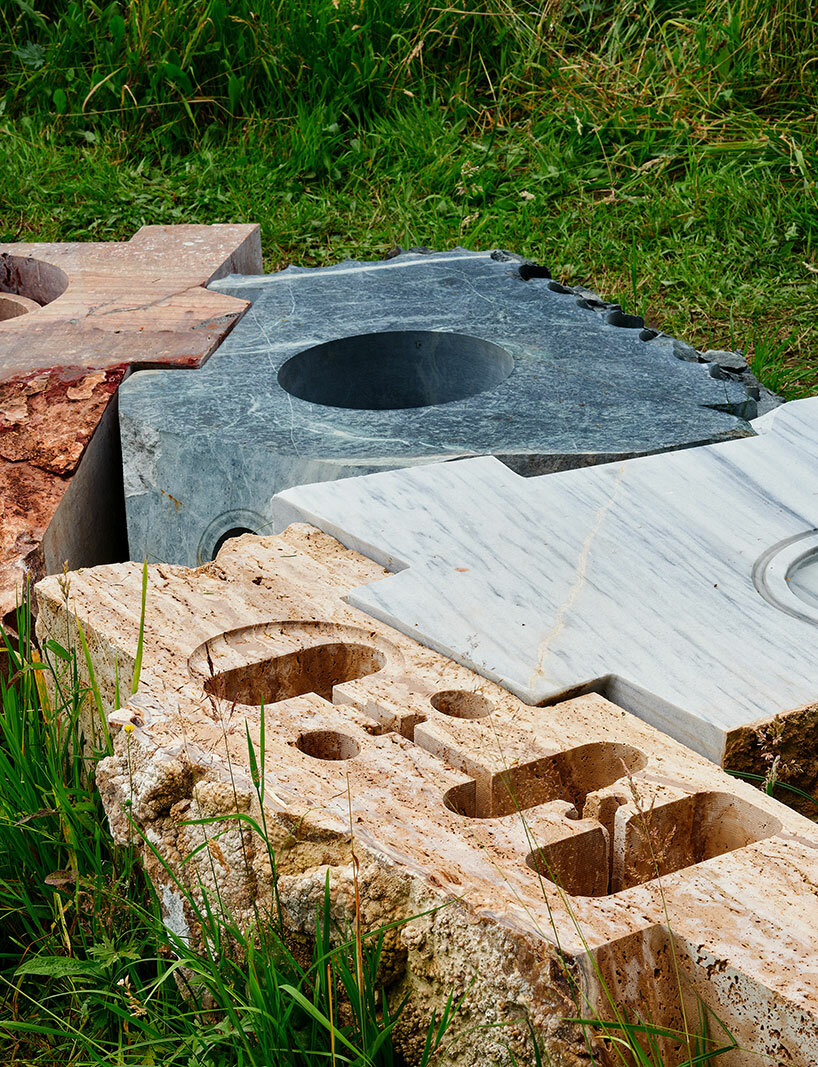
The Transspecies Kitchen, Office for Political Innovation, Antwerp, Belgium, 2024. image © José Hevia (see here)
DB: Do you have advice for younger designers or emerging practices who recognize these issues but may not have the means to address them yet?
AJ: Architecture demands a high level of commitment. Some professions prioritize continuity, while others prioritize criticality. Architecture increases criticality, which expands opportunities for experimentation and responsiveness.
It requires sensitivity to the world and the ability to anticipate change. This makes it both highly relevant and deeply challenging.
Architects need each other. There is a need for solidarity within the discipline. Only by working together can we identify problems and develop alternatives.
Each field carries a different kind of emotional investment. In architecture, there is excitement in anticipating change, alongside the difficulty of realizing it. That shared condition is what brings us together.

COSMO Water Purifier, Office for Political Innovation, MoMA PS1, New York, 2015. image © Miguel de Guzmán
project info:
architect: Andrés Jaque – Office for Political Innovation
The post ‘utopia is growing within the cracks’: andrés jaque on possibility as architectural system appeared first on designboom | architecture & design magazine.