

The terms BIM 3D, 4D, and 5D have long been used to describe the level of BIM adoption in a project. While they may sound intuitive, this “dimension-based” approach often leads to different interpretations among project stakeholders.
For example, BIM 4D is commonly understood as a model linked to a construction schedule. In practice, however, there is no clear or consistent definition of how that linkage should be. A similar issue exists with BIM 5D, which is typically associated with cost, yet the scope, level of detail, and expected outputs can vary significantly from one project to another.

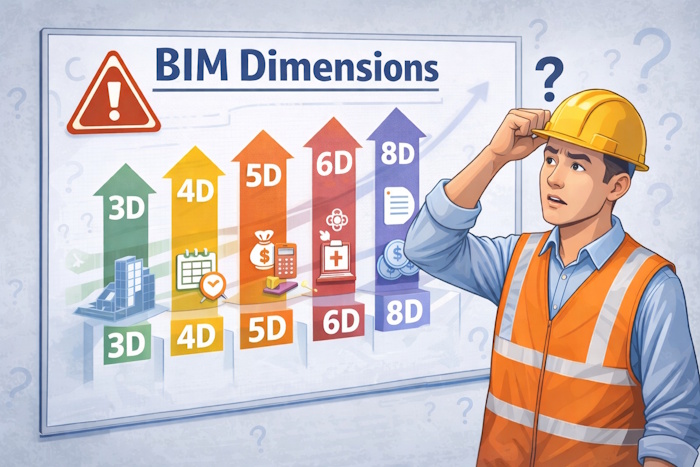
BIM dimensions also tend to create misleading expectations. When a project is described as implementing BIM 7D, there is often an assumption that it must automatically include 3D, 4D, 5D, and 6D as well, even if those uses are not actually required.
As a result, BIM dimensions function more as labels than as practical tools for technical communication. In a collaborative project environment, this ambiguity can lead to misaligned expectations between owners, consultants, and contractors. Ultimately, projects may become burdened with unnecessary detail simply because the BIM implementation was never clearly defined.
Defining BIM Uses in a Project
A clearer and more structured approach is to define BIM Uses. BIM Use explicitly describes how the BIM model will be used to support business and technical processes within a project.
Common examples of BIM Uses include:
- Design coordination and clash detection
- Quantity take-off and cost estimation
- Construction sequencing and method planning
- Shop drawings and fabrication support
- Asset information for handover and operations
A project may adopt one or multiple BIM Uses, depending on its objectives.
By defining BIM Uses from the outset:
- The purpose of BIM becomes explicit
- The BIM scope can be derived more accurately
- The risk of miscommunication between stakeholders is reduced
- BIM delivery becomes more efficient, avoiding both over-modeling and under-modeling
Within the ISO 19650 framework, BIM Use is closely linked to the definition of Exchange Information Requirements (EIR). EIR does not ask whether a project requires “BIM 4D or 5D.” Instead, it focuses on what information is required, when it is required, and for what purpose. In this sense, BIM Use becomes the foundation for defining project information requirements.
Applying the Right LOIN for Each BIM Use
Once BIM Uses are clearly defined, the next step is determining the appropriate Level of Information Need (LOIN). ISO 19650 emphasizes that information should be fit for purpose, not excessive.
LOIN consists of three main components:
- Level of Geometry: the required geometric detail of model elements
- Level of Information: non-geometric attributes and data
- Level of Documentation: supporting deliverables such as drawings or schedules
Each BIM Use requires a different LOIN. For example:
- Design coordination requires geometry that is accurate enough for clash detection, but not fabrication-level detail
- Quantity take-off requires consistent classification and quantity-related properties, but not necessarily highly detailed geometry
- Construction planning requires elements to be linked to zones, phases, or construction activities
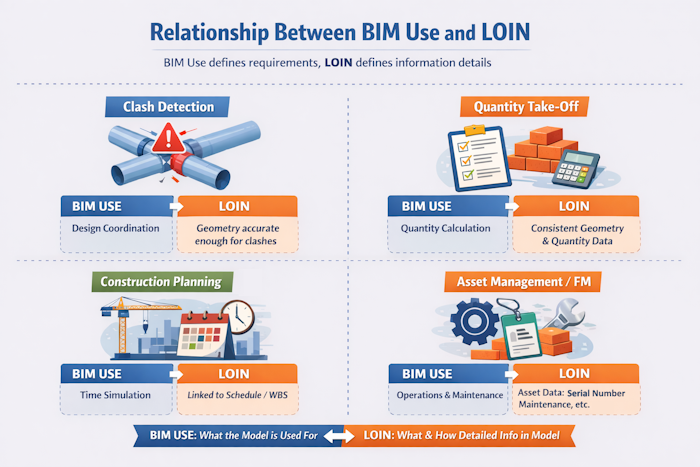
This approach aligns directly with ISO 19650 principles, ensuring that information is produced at an appropriate level for its intended use. LOIN, therefore, becomes a key mechanism for both quality control and efficiency in the production of BIM information.
BIM Dimensions Are No Longer Sufficient
The use of BIM dimension terms such as 3D, 4D, and 5D is no longer sufficient to describe BIM requirements in increasingly complex construction projects. These terms are inherently ambiguous and do not clearly represent actual information needs. While they may still be acceptable at a conceptual level, they must be accompanied by precise definitions and scope.
A more effective and ISO 19650-aligned approach is to:
- Clearly define BIM Uses based on project objectives
- Specify appropriate LOIN for each BIM Use
- Link both to EIR and structured information management within the CDE
This approach ultimately improves collaboration quality, clarity of expectations, and, most importantly, the overall success of BIM implementation across the project lifecycle.