
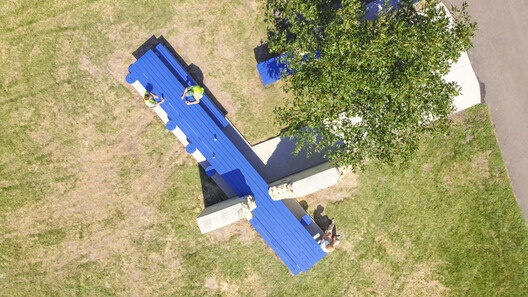
The Dining Room Installation / i/thee . Image © Neal Lucas Hitch
A long table can sit almost anywhere and still do the same work. It can stretch beneath a market canopy, run along a school dining hall, or occupy the center of a shared living room, and it immediately changes the room’s temperature.
That is why the long table is less an object than a spatial instrument. It does not guarantee a connection, and it rarely looks “inclusive” by default. Instead, it sets conditions: a shared edge, a common rhythm of arrival, a field of mutual visibility, or a rule that turns eating into a scene with others. Food studies describe this practice as commensality, the act of eating together and the social order it can create, reinforce, or contest. But what matters here is not a specific dimension or the table’s function, but the way a long surface holds difference, conversation, and silence; intimacy and distance; the decision to join and the right to hesitate.